A long time ago I started some blog-posts, but never found the time nor energy to finish them. Now I have long lost interest in the matter and will publish them all "as is" – maybe someone will find these raw thoughts helpful.
Showing posts with label HIV. Show all posts
Showing posts with label HIV. Show all posts
Tuesday, January 14, 2014
Unfinished Blog-Post: To Pull A Gallo
A long time ago I started some blog-posts, but never found the time nor energy to finish them. Now I have long lost interest in the matter and will publish them all "as is" – maybe someone will find these raw thoughts helpful.
BTW: It is this post I most regred not finishing – it is mainly missing one table in the middle, listing some parallels between the story of "Fictional Gallo" and those who brought us the XMRV fraud. However the so inclined readers might be able to find parallels by themselves.
BTW: It is this post I most regred not finishing – it is mainly missing one table in the middle, listing some parallels between the story of "Fictional Gallo" and those who brought us the XMRV fraud. However the so inclined readers might be able to find parallels by themselves.
Tuesday, October 30, 2012
HIV unimpressed by Stress Management – Proponents of Behavioral Interventions "surprised" by this
Stress Management Interventions for HIV+ Adults: A Meta-Analysis of Randomized Controlled Trials, 1989 to 2006And yeah, before "concluding that stress management interventions are ineffective" one should however try to rationalize a lot (and then some) that it was "just this time" that your psych*–woo did not work, because HIV was so devastating.
Lori A. J. Scott-Sheldon
Center for Health and Behavior, Syracuse University
Seth C. Kalichman
Center for Health, Intervention, and Prevention
Michael P. Carey and Robyn L. Fielder
Center for Health and Behavior, Syracuse University
Abstract
Objective:
Numerous studies document that stress accelerates disease processes in a variety of diseases including HIV. As a result, investigators have developed and evaluated interventions to reduce stress as a means to improve health among persons living with HIV. Therefore, the current meta-analysis examines the impact of stress-management interventions at improving psychological, immunological, hormonal, and other behavioral health outcomes among HIV+ adults.
Design
This meta-analytic review integrated the results of 35 randomized controlled trials examining the efficacy of 46 separate stress-management interventions for HIV+ adults (N = 3,077).
Main Outcome Measures
Effect sizes were calculated for stress processes (coping and social support), psychological/psychosocial (anxiety, depression, distress, and quality of life), immunological (CD4+ counts and viral load), hormonal (cortisol, dehydroepiandrosterone sulfate [DHEA-S], cortisol/DHEA-S ratio, and testosterone) and other behavioral health outcomes (fatigue).
Results
Compared to controls, stress-management interventions reduce anxiety, depression, distress, and fatigue and improve quality of life (d+s = 0.16 to 0.38). Stress-management interventions do not appear to improve CD4+ counts, viral load, or hormonal outcomes compared with controls.
Conclusion
Overall, stress-management interventions for HIV+ adults significantly improve mental health and quality of life but do not alter immunological or hormonal processes. The absence of immunological or hormonal benefits may reflect the studies' limited assessment period (measured typically within 1-week post-intervention), participants' advanced stage of HIV (HIV+ status known for an average of 5 years), and/or sample characteristics (predominately male and Caucasian participants). Future research might test these hypotheses and refine our understanding of stress processes and their amelioration.
…
To our surprise, we did not find evidence that stress reduction interventions improved immune functioning or hormonal mechanisms that could influence immunity. These findings contrast with the PNI perspective that guided our work and most of the interventions included in our review (Antoni, 2003; Robinson et al., 2000). Thus, even though chronic stressors are known to suppress both cellular and humoral markers (see Segerstrom & Miller, 2004); the short-term use of stress management strategies does not seem to reverse these processes in patients with HIV. Before concluding that stress management interventions are ineffective in improving the immunological health of people living with HIV/AIDS, however, it is appropriate to consider potential alternative explanations for these null effects. For example, it is possible that even the most potent stress management intervention will be unable to overcome the devastating effects of HIV on the immune system. …
And why is not enough for these psych*-quacks to "improve mental health and quality of life"? Why do they have to cling on to their idealistic (and anti-evolutionary) mind-body BS that "IT'S THE MIND THAT CAUSES ILLNESS!"?
(via)
Monday, March 19, 2012
Is health-care a medical or a social problem?
The savage cuts to Greece's health service budget have led to a sharp rise in HIV/Aids and malaria in the beleaguered nation, said a leading aid organisation on Thursday.It seems to me that access to health-care is the primary determinant for the quality of health-care – the biggest improvement for a health-care system is making sure all people have access.
The incidence of HIV/Aids among intravenous drug users in central Athens soared by 1,250% in the first 10 months of 2011 compared with the same period the previous year, according to the head of Médecins sans Frontières Greece, while malaria is becoming endemic in the south for the first time since the rule of the colonels, which ended in the 1970s.
Reveka Papadopoulos said that following health service cuts, including heavy job losses and a 40% reduction in funding for hospitals, Greek social services were "under very severe strain, if not in a state of breakdown. What we are seeing are very clear indicators of a system that cannot cope". The heavy, horizontal and "blind" budget cuts coincided last year with a 24% increase in demand for hospital services, she said, "largely because people could simply no longer afford private healthcare. The entire system is deteriorating".
Friday, February 24, 2012
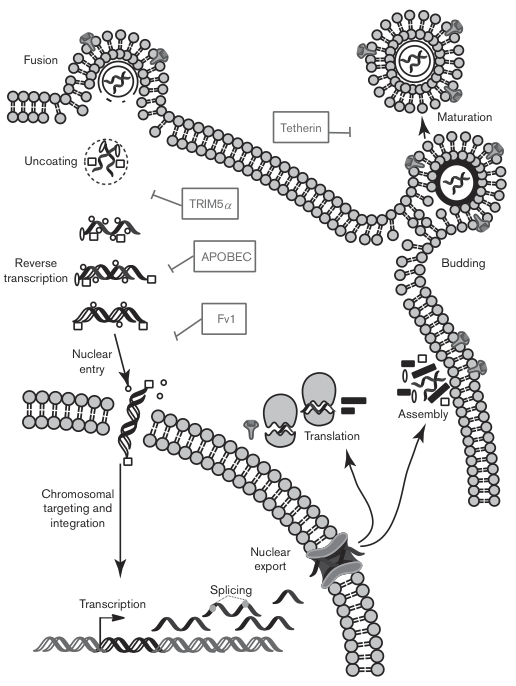
Retrovirus Life Cycle and Targeting by Host Restriction Factors
From: The tale of xenotropic murine leukemia virus-related virus
Harriet C.T. Groom and Kate N. Bishop
MRC National Institute for Medical Research, London, UK
(PDF freely available from the journal)
Thanks Maarten Maartensz (and CO-CURE) for the link!

Harriet C.T. Groom and Kate N. Bishop
MRC National Institute for Medical Research, London, UK
(PDF freely available from the journal)
Thanks Maarten Maartensz (and CO-CURE) for the link!
Retrovirus life cycle and targeting by host restriction factors.
So much for the basics.Simplified schematic of the life cycle of a simple exogenous retrovirus (scale and numbers are illustrative only).Major stages of replication:
Host restriction factors:
- Fusion
- Uncoating
- Reverse Transcription
- Nuclear Entry
- Chromasomal Targeting and Integration
- Transcription
- Splicing
- Nuclear Export
- Translation
- Assembly
- Budding
- Maturation
- APOBEC3G inhibits cDNA synthesis and induces mutation of the virus genome
- TRIMα targets the virus at a stage after entry but before reverse transcription
- Fv1 inhibits replication after reverse transcription but before integration
- Tetherin prevents mature virus-particle release (budding/maturation) from the cell
… The Xpr1 receptor is expressed widely on human cells (Kozak, 2010) and XMRV was demonstrated to infect various human cell lines, including those derived from PC [Prostate Cancer] (Dong et al., 2007; Groom et al., 2010b; Rodriguez & Goff, 2010; Stieler et al., 2010). However, infection appeared to be inhibited in other cell types in vitro (Groom et al., 2010b; Stieler et al., 2010). …Translated to english: XMRV can infect some cell lines, in the lab ("in vitro"), but some other cell lines inhibit XMRV infection.
… No APOBEC3G was detected in PC cell lines or primary prostatic stromal fibroblasts (Paprotka et al., 2010; Stieler et al., 2010), perhaps explaining the efficient replication of XMRV in these cells. …
Translated to english: XMRV spreads in some cell lines, because some cell lines are missing bits and pieces, which are present in human PBMCs in vivo.
As well as requiring the correct receptor, the species specificity and tissue tropism of a virus are in part determined by the expression of a range of cellular restriction factors. Some restriction factors found in human PBMCs have previously been shown to inhibit MLV replication (Fig. 1), so it was surprising that XMRV could reportedly be isolated from blood (Lombardi et al., 2009). Intrigued by the possibility that XMRV had mechanisms to overcome restriction factors that other MLVs lacked, we and others investigated the susceptibility of XMRV to these factors (Bogerd et al., 2011; Groom et al., 2010b; Paprotka et al., 2010; Stieler & Fischer, 2010). We showed that members of the human APOBEC3 family, as well as Tetherin, were able to restrict XMRV infection, although human TRIM5α was not. APOBEC3G and Tetherin are expressed in PBMCs, so it was unlikely that XMRV could maintain an efficient spreading infection in these cells.
Translated to english: Anybody telling you that XMRV spreads in human PBMCs is full of shit.
Neither XMRV nor their ancestoral MLV's have capablities to overcome human defenses against retroviruses. They can not infect a human (these viruses can not "maintain an efficient spreading infection").
As a end-note: The mystical "HGRV", which is rumored to be a relative of MLV's and to have gathered several capabilities to overcome human anti-retroviral defenses – capabilities which are missing in his relatives – has so far not been demonstrated to exist. Maybe it is spread by animals living in the Bavarian forest…
Neither XMRV nor their ancestoral MLV's have capablities to overcome human defenses against retroviruses. They can not infect a human (these viruses can not "maintain an efficient spreading infection").
As a end-note: The mystical "HGRV", which is rumored to be a relative of MLV's and to have gathered several capabilities to overcome human anti-retroviral defenses – capabilities which are missing in his relatives – has so far not been demonstrated to exist. Maybe it is spread by animals living in the Bavarian forest…
In Bavarian folklore, a wolpertinger (also called wolperdinger, poontinger or woiperdinger) is an animal said to inhabit the alpine forests of Bavaria in Germany. It has a body comprised from various animal parts — generally wings, antlers, tails and fangs, all attached to the body of a small mammal. The most widespread description is that of a horned rabbit or a horned squirrel.
Stuffed "wolpertingers", composed of parts of actual stuffed animals, are often displayed in inns or sold to tourists as souvenirs in the animals' "native regions". The Deutsches Jagd- und Fischereimuseum in Munich, Germany features a permanent exhibit on the creature.
It is similar to other creatures from German folklore, such as the Rasselbock of the Thuringian Forest, or the Elwedritsche of the Palatinate region, which is described as a chicken-like creature with antlers; additionally the American Jackalope, as well as the Swedish Skvader are in ways similar to the Wolpertinger.

Wednesday, February 22, 2012
Oh, the Irony (2)
Wikipedia on AIDS denialism:
At an April 23, 1984 press conference in Washington, D.C., Margaret Heckler, Secretary of Health and Human Services, announced that Gallo and his co-workers had discovered a virus that is the "probable" cause of AIDS. This virus was initially named HTLV-III. That same year, Casper Schmidt responded to Gallo's papers with "The Group-Fantasy Origins of AIDS", which was published by the Journal of Psychohistory. Schmidt posited that AIDS was not an actual disease, but rather an example of "epidemic hysteria" in which groups of people are subconsciously acting out social conflicts. Schmidt compared AIDS to documented cases of epidemic hysteria in the past which were mistakenly thought to be infectious. (Schmidt himself would later die of AIDS in 1994.)
HIV and The American Isolate
Why does BRU remind my of VP62?


FIG. 1. Phylogenetic relationships among HIV isolates. Each isolate name is accompanied by the year of isolation (see table 1); e.g., BH8 is given as BH/83. Although BRU was taken from a French man, it is considered as an American isolate because the subject had probably become infected during his stay in the United States (Alizon et al. 1986). RF was isolated from a Haitian man in Philadelphia, and WMJ 1, WMJ2, and WMJ3 were isolated from a Haitian child in Miami. See text for the determination of the branching order. The branch lengths are determined by Li’s ( 1981) method. The number on each branch is the percent sequence divergence.Just like "VP62" from Lombardi et al. 2009, almost no difference:
From:
Rates and Dates of Divergence between AIDS Virus Nucleotide Sequences
Wen-Hsiung Li, Masako Tanimura, and Paul M. Sharp
Center for Demographic and Population Genetics, University of Texas


Robert Gallo is an honest scientist
Robert Gallo was honest about HIV if and only if (iff) Luc Montagnier was not.(Kudos to Maarten Maartens giving me the idea for the "if and only if (iff)" phrase)
Tuesday, February 21, 2012
The Lost Year with Robert Gallo
About the "Gallo machine", a letter from Abraham Karpas ScD, Assistant Director of Research, University of Cambridge, Department of Haematology:
Dear Dr Windom(PDF)
…
In conclusion the AIDS virus could and should have been isolated in the USA for the following reasons:
The latter reason could have been sufficient for the US to be the first to isolate the causative virus. However, because of Dr Gallo, the French were first. Progress in AIDS research has been delayed by a full year while Drs Gallo and Essex published eight articles on HTLV, the rare human leukaemia virus, as the cause of AIDS. In the process they prevented directly and indirectly the publication of medical and scientific data that HTLV was not involved in AIDS and that another virus was the cause of this new disease. As a result many thousands of individuals became infected with contaminated blood and the virus kept spreading at an accelerated pace. Only after Dr Gallo received the AIDS virus from France and managed to grow it did he change its name from LAV to HTLV-III and claim himself as the discoverer. In order to justify calling it HTLV-III, Gallo with Wong-Staal presented scientific "data" on the similarity of the HTLV-I and HTLV-III which they published in Science and Nature, thereby causing further delay in AIDS research by sending newcomers to this field into blind alleys.
- It was in the US that AIDS was first recognized as a new disease of man in 1981 by Gottlieb and others
- The US had the largest number of diagnosed AIDS patients
- The US scientific and medical might, in particular having excellent retrovirologists in Tenim, Bishop, Baltimore etc.
There is no question in my mind that Dr Gallo is responsible for the large number of infections especially through blood transfusions during the lost year. …
Gallo's 48 isolates spoke French with a single voice.Gallo had his 48 samples, and the 48 samples all spoke BRU with a single voice. Mikovits has her "68" samples… and the 68 samples spoke VP62 with a single voice.
Friday, January 20, 2012
How many different antibodies for an retrovirus like HIV?
Each bacteria has multiple sites that can elicit an antibody response. It is not one organism, one antibody. The number of antibodies that the body develops against a germ depends on the the complexity of the organism which in turn determines how many antibodies are made against a particular organism. We use the multiple antibodies made for some organisms diagnostically. For a simple organisms like HIV, we do a western blot and look for the presence of an antibody response to 8 different proteins. For Lyme, we look for antibody response to 10 proteins. For more complex organism like S. aureus we can make dozens of different antibodies.
Monday, January 9, 2012
How people react when they find out their positive HIV test was false
The reaction of those identified as false-positive varied. One woman said that her husband had divorced her, and she had remarried someone from the HIV+ peer support group. A pastor was immensely relieved to hear that he was HIV-negative, since he could never figure out how he got infected. Some felt it was a miracle from God, or evidence that the latest magic potion on the market cured HIV.The human mind – it puzzles my mind.
Subscribe to:
Posts (Atom)